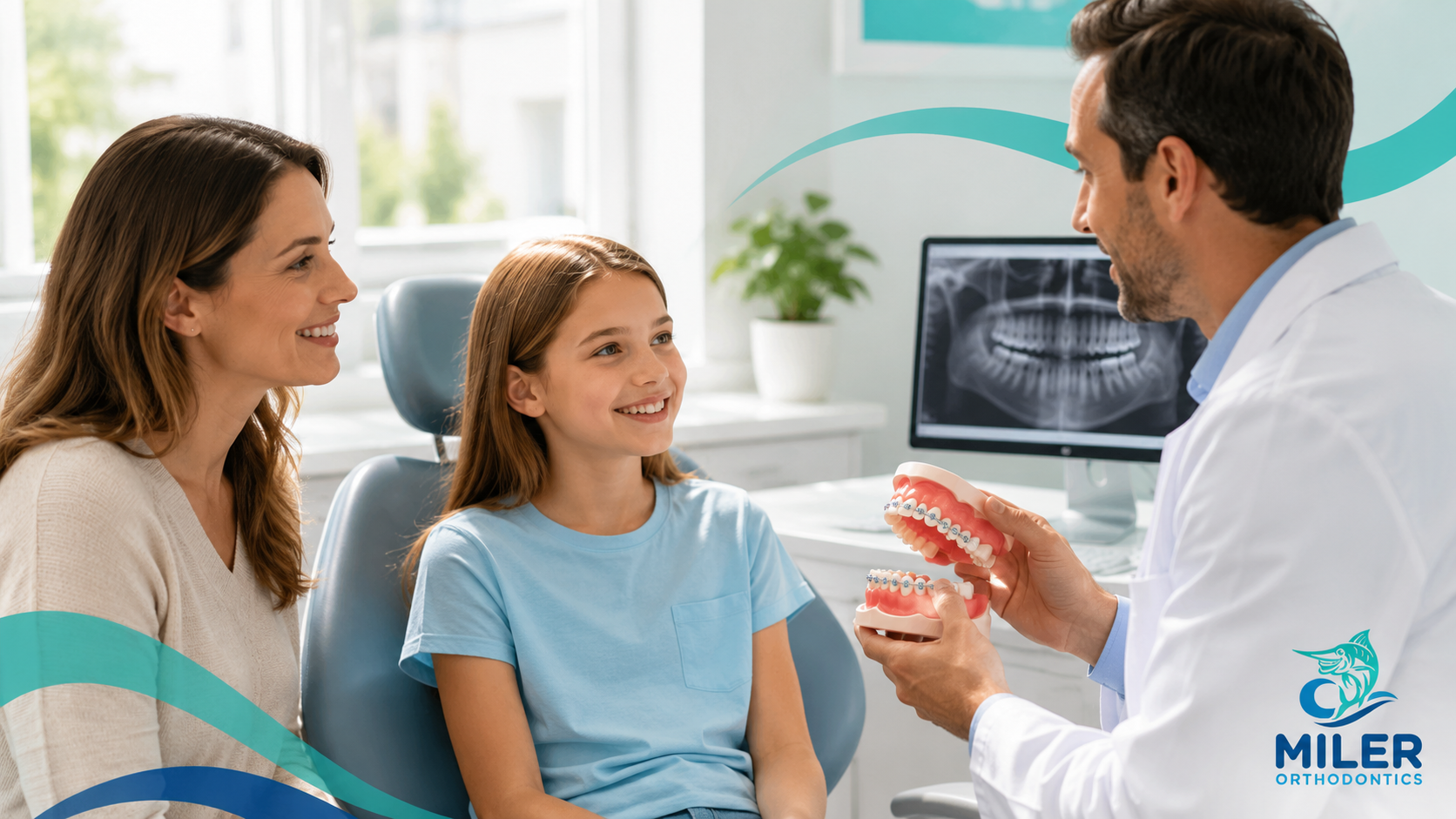
Most children should have their first orthodontic evaluation by age 7, but that does not mean they will need braces at that age. An orthodontist checks how the permanent teeth, bite, and jaws are developing and may recommend treatment now or continued monitoring. Miler Orthodontics provides children’s orthodontic care for families in Beaufort and throughout the South Carolina Lowcountry.
Why Should Kids See an Orthodontist Around Age 7?
The American Association of Orthodontists recommends an orthodontic checkup by age 7. At this stage, many children have a mix of baby teeth and permanent teeth, which makes it easier to see how the teeth and jaws are developing. The orthodontist may check for crowding, teeth coming in at unusual angles, overbites, underbites, crossbites, trouble chewing, or a jaw that shifts when your child bites.
Finding one of these issues does not always mean treatment should start right away. Many children are simply monitored as they grow so the orthodontist can see how the permanent teeth and jaws continue to develop.
When Do Kids Usually Get Braces?
There is no single age that is right for every child. The age-7 visit is mainly an evaluation, not a deadline for starting braces. Some children may benefit from early orthodontic treatment while they still have a mix of baby and permanent teeth, while others may wait until more permanent teeth have come in.
The timing depends on your child’s bite, tooth alignment, and jaw growth. The goal is to begin treatment when it is most useful for that child’s development rather than choosing braces based on age alone.
What Signs May Mean My Child Needs Braces?
Parents may want to schedule an orthodontic evaluation if a child has crowded or crooked teeth, large gaps, teeth that stick out, trouble chewing, or a noticeable overbite, underbite, or crossbite. Early or late loss of baby teeth and a jaw that shifts when closing can also be worth checking.
Some orthodontic problems are easy to notice at home, while others may only be found during an exam. An evaluation can help determine whether the issue needs treatment or simply needs to be watched as your child grows.
What Types of Braces Might an Orthodontist Recommend?
The type of braces recommended depends on your child’s orthodontic needs, age, and preferences. Traditional metal braces use brackets and wires to gradually move the teeth and are commonly used for children and teens because they can correct many types of alignment and bite problems.
Ceramic braces work in a similar way but use less noticeable brackets. They may appeal to older children or teens who prefer a more subtle look while still receiving fixed orthodontic treatment.
What Happens at a Child’s Orthodontic Consultation?
The first orthodontic visit is usually straightforward. The orthodontist will examine your child’s teeth, bite, and jaw growth, and photos or X-rays may be taken if they are needed to understand how the teeth are developing.
After the exam, parents should have a clearer idea of whether treatment is needed now, whether the child should be monitored, or whether braces may be recommended later. The visit is also a good time to ask questions about treatment timing and the options that may fit your child’s needs.
Frequently Asked Questions About Braces for Kids
If you are unsure whether your child is ready for braces, an orthodontic consultation can help clarify the next step. Miler Orthodontics provides children’s orthodontic care at 1600 Burnside St., Suite 105, Beaufort, SC 29902. Call or text 843-379-9200 to get started.