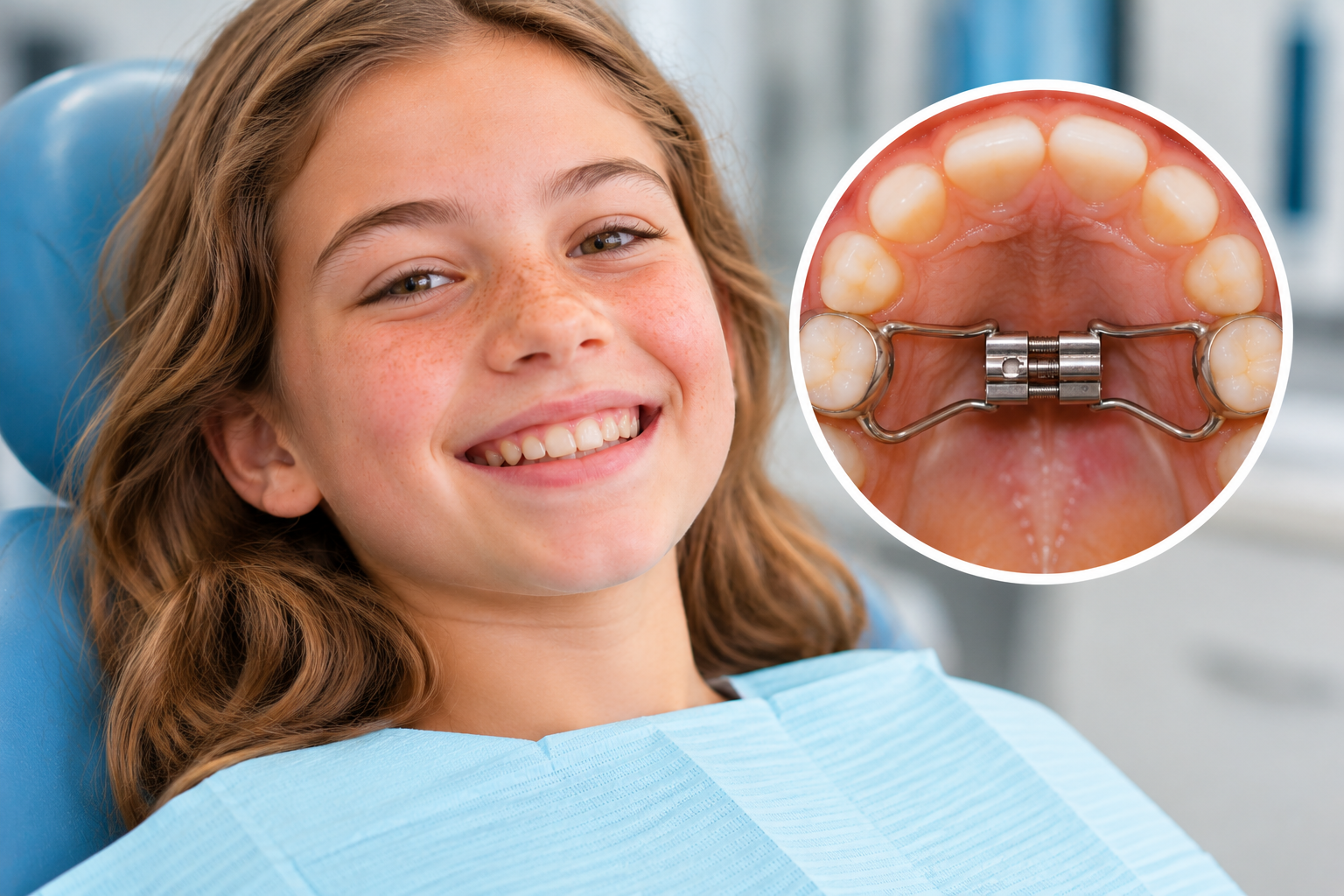
Quick Answer: Not every child needs a palate expander before braces. An expander may help if your child’s upper jaw is too narrow or they have a crossbite. It gradually widens the upper jaw to improve how the teeth fit together and create room for permanent teeth. Children with enough jaw width may only need braces. At Miler Orthodontics in Bluffton and Beaufort, SC, Dr. Sherwood Miler can evaluate your child’s bite and jaw growth to determine whether expansion is necessary.
Why Would My Child Need a Palate Expander?
Your child’s permanent teeth are coming in crooked or overlapping. But the problem may not be the teeth themselves. Their upper jaw could be too narrow.
A palate expander gradually widens the upper jaw to help the upper and lower teeth fit together properly. It may also create more space for permanent teeth. Braces, on the other hand, move teeth into better positions.
If the upper jaw is too narrow, straightening the teeth alone may not correct the underlying bite problem. Expansion may be recommended to address the jaw width before or alongside braces.
What Are the Signs My Child Might Need an Expander?
A common sign of a narrow upper jaw is a crossbite. This happens when some upper teeth sit inside the lower teeth when your child bites down. You may notice that your child’s upper back teeth fit inside their lower teeth or that they shift their jaw to one side when closing their mouth.
Other signs include crowded upper teeth, permanent teeth coming in at unusual angles, or an uneven bite. For example, your child’s front teeth may look straight, but their back teeth might not line up correctly.
These signs can have different causes, so an orthodontic examination is needed to understand the problem. Miler Orthodontics offers early orthodontic treatment to identify concerns with tooth and jaw development while children are still growing.
Does My Child Need an Expander Before Braces?
The right treatment depends on what is causing your child’s bite or spacing problem.
For example, a child with a narrow upper jaw and crossbite may benefit from expansion. A child whose jaw is wide enough but whose front teeth overlap may only need braces.
Some children use an expander and braces during the same treatment period. Others complete expansion first and begin braces after more permanent teeth have come in. If the bite is developing normally, the orthodontist may recommend monitoring rather than immediate treatment.
The order of treatment is based on the child’s needs, not a standard schedule that applies to everyone.
How Does an Orthodontist Decide if My Child Needs an Expander?
During an orthodontic evaluation, Dr. Miler checks how your child’s upper and lower teeth fit together, whether the upper jaw is too narrow, and how the permanent teeth are developing. He also considers how much jaw growth remains. Photos or X-rays may be used when needed to get a clearer view of the teeth and jawbones.
These findings help determine whether the problem involves jaw width, tooth position, or both. Parents can also ask what changes the orthodontist will monitor and whether treatment needs to begin immediately.
Miler Orthodontics offers several early treatment options, including palate expanders, space maintainers, and partial braces. A space maintainer holds room for a permanent tooth after early tooth loss, while partial braces can help correct certain tooth positions. Each treatment serves a different purpose.
When Is the Best Time to Start Palate Expansion?
The American Association of Orthodontists recommends a child’s first orthodontic checkup by age 7. This allows an orthodontist to identify developing bite problems before all permanent teeth have come in.
Some children benefit from expansion around ages 7 to 10, while others may need treatment later. The best time depends on jaw growth rather than age alone.
For example, a 7-year-old with a crossbite may benefit from early treatment, while another child of the same age with a healthy bite may only need regular checkups. If your child is already 11 or 12, expansion may still be an option. An orthodontist can assess their growth and explain which approach may work.
What Should My Child Expect During Palate Expander Treatment?
A palate expander usually fits across the roof of the mouth and connects to the upper teeth. Some types have a small screw that parents adjust with a special key. Your orthodontist will explain how and when to make adjustments.
During the first week, your child may feel mild pressure or soreness, speak a little differently, or find certain foods harder to chew. Softer meals like scrambled eggs, pasta, yogurt, and mashed potatoes can make eating easier. Food may also become trapped around a fixed expander, so careful brushing and following the orthodontist’s cleaning instructions are important.
Treatment usually has two stages. First, the appliance gradually widens the jaw, often over several weeks. It then stays in place for additional months to help keep the new width stable. Contact the orthodontist if your child experiences strong or lasting pain.
Frequently Asked Questions About Palate Expanders
Can my child have crowded teeth without needing a palate expander?
Yes. Crowded teeth do not always mean the upper jaw is too narrow. Some children have enough jaw space but need their teeth moved into better positions. An orthodontist can determine what is causing the crowding.
What happens if a narrow upper jaw is left untreated?
A narrow upper jaw can cause certain bite problems to continue as a child grows. Some problems may become harder to correct once jaw growth is complete. However, the need for treatment depends on the child’s bite and jaw development.
Can a palate expander help prevent tooth extractions?
Sometimes. Widening the upper jaw may create more room for permanent teeth and reduce the need for extractions in certain cases. However, expansion cannot guarantee that tooth removal will be avoided.
How should my child clean their palate expander?
Your child should brush around the appliance carefully to remove food and plaque. An interdental brush or water flosser may help clean hard-to-reach areas if recommended by the orthodontist. Cleaning instructions may differ depending on the type of expander.
Will my child’s front teeth develop a gap during expansion?
A small gap may form between the upper front teeth as the jaw widens. This can be a normal part of treatment, although not every child develops a visible gap. The space may change over time, and braces may later be used to adjust the tooth positions if needed.
Find Out if Your Child Needs a Palate Expander in Bluffton or Beaufort, SC
If your child’s teeth look crowded or their bite seems uneven, an orthodontic evaluation can help identify the cause and determine whether treatment is needed.
At Miler Orthodontics, board-certified orthodontist Dr. Sherwood Miler evaluates children’s teeth, bite, and jaw growth. Families in Bluffton and Beaufort, SC, can learn whether an expander, braces, or continued monitoring is appropriate.
Schedule a complimentary orthodontic consultation to discuss your child’s treatment options and next steps.
Bluffton: 843-815-2521
Beaufort: 843-379-9200